Our Archive Discoveries
Świlcza had a parish priest already in 1424
Świlcza · Gmina Świlcza, Rzeszów County, Podkarpackie Voivodeship, Poland
A gmina village 8 km west of Rzeszów
In 1624 the Tatars burned the church at Świlcza, “and all the grants were lost”. That is why Polish Wikipedia gives no medieval date for the village. But what burned in Świlcza survived elsewhere: in a charter of the Archbishop of Lwów from 1424.
Research and text: Vadym Ratynskyi
- In the record
- 15 November 1424
- Usually given
- no medieval date
- Difference
- first dated record
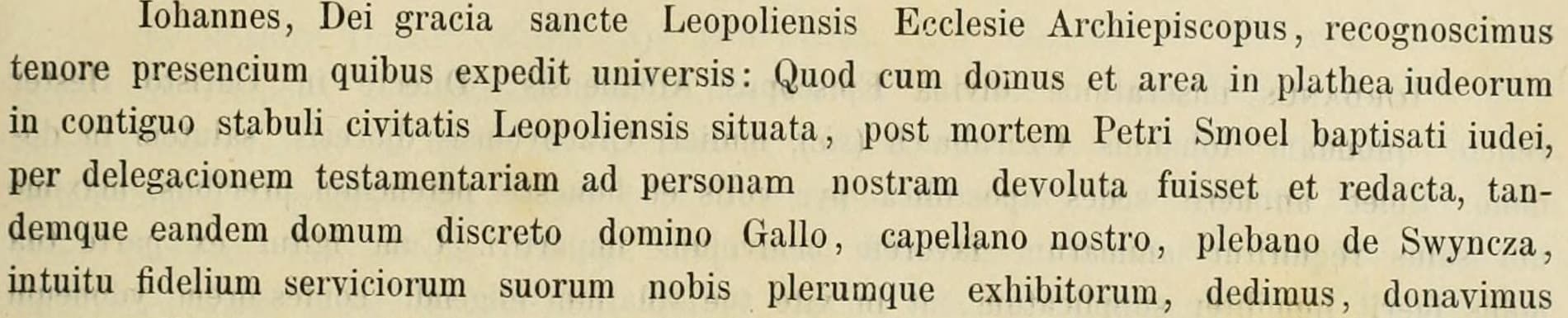
The entry, as printed
Iohannes, Dei gracia sancte Leopoliensis Ecclesie Archiepiscopus, recognoscimus … tandemque eandem domum discreto domino Gallo, capellano nostro, plebano de Swyncza, intuitu fidelium serviciorum suorum nobis plerumque exhibitorum, dedimus, donavimus et contulimus…
In English
We, Jan, by the grace of God Archbishop of the holy Church of Lwów, declare … and finally we gave, granted and conferred that house on the honourable lord Gallus, our chaplain, parish priest of Świńcza, in view of the faithful services he has often rendered us…
Burned in Świlcza, kept in Lwów
The Geographical Dictionary of the Kingdom of Poland says that in 1624 the Tatars destroyed Świlcza, also called Świńcza, “and burned the church, whereby all the grants were lost”. Polish Wikipedia gives the old name, Świńcza, and says in general that the village’s roots go back to the 14th century. It gives no medieval date.
Documents about Świlcza survived, however, where no one burned them: in the archive of the city of Lwów and in the Przemyśl court books.
The archbishop’s chaplain, 1424
On 15 November 1424, in Lwów, Archbishop Jan confirmed the sale of a house in Jewish Street. After the death of Piotr Smoel, a baptised Jew, the house had passed to the archbishop, who gave it to “the honourable lord Gallus, our chaplain, parish priest of Świńcza”, for his faithful service. The house fell into ruin, Gallus had no means to rebuild it, and with the archbishop’s consent he sold it to the city councillors.
The original on parchment, with a small seal bearing the Półkozic arms, was kept in the Lwów city archive as no. 115. It was printed in volume IV of the “Akta grodzkie i ziemskie” in 1873. So Świlcza had a parish and a parish priest already in 1424.
Why the archbishop’s chaplain was priest at Świlcza
Archbishop Jan, who died in 1436, came from the lords of Rzeszów, and Świńcza was among his estates. We know this from an entry of late 1444, when his grandchildren, three brothers named Jan, heirs of Staromieście, and Małgorzata, wife of lord Mościc, divided what had “fallen to them after the death of the most reverend lord Jan, formerly Archbishop of Lwów, their grandfather”.
A chaplain given the parish in his lord’s family village was an entirely ordinary thing in the 15th century.
A headman in turns and a forest in case of fire
The division of 1444 is a lively story of its own. Małgorzata took half of Świńcza “on the side where the manor is”, the brothers the other half, “where the church is”, together with the “old pond”. Kameszyn, today part of Świlcza, was split in two.
What could not be divided was shared in turns. The village headman was to serve the brothers for a year, from Assumption to Assumption, then Małgorzata for a year, “and so in order”. The parish priest was to be presented in turns in the same way. And if, “God forbid, the town should burn”, Małgorzata’s half of Rzeszów could cut timber in the brothers’ forest for a year to rebuild.
How we know it is this Świlcza
Wikipedia and the Geographical Dictionary both say Świlcza used to be called Świńcza. The Dictionary describes it together with Kameszyn: “Świlcza with Kameszyn”. The 1444 entry divides Świńcza in exactly that way, “up to half of Kamyszyn”. And the 1424 charter was issued by an archbishop from the family of the lords of Rzeszów, to whom Świńcza belonged.
Whether the first volume of the “History of Rzeszów” (1994) knows the 1424 charter, we have not checked. The date has not reached Wikipedia.
Sources
- Akta grodzkie i ziemskie, vol. IV (Lwów, 1873), doc. LXVIII, p. 127 (Lwów, 15 November 1424).
- Akta grodzkie i ziemskie, vol. XIII (Lwów, 1888), p. 170, no. 2385 (late 1444).
- Słownik geograficzny Królestwa Polskiego, vol. XI (Warsaw, 1890), entry “Świlcza z Kameszynem”.
© 2026 Vadym Ratynskyi. All rights reserved. The research, text and translations on this page may be copied or republished only with the author's permission. To ask for permission, write to hello@ukrainianhomecoming.com.
Is your family from Świlcza?
These records are about lords and land. Your ancestors are far more likely to be in the parish registers of the 18th to 20th centuries, and for most villages of this area some of those books survive, in archives in Ukraine and in Poland. A $140 records check tells you what exists for your village before you pay for anything larger.
Our Archive Discoveries
8 October 1436
Prałkowce
38 years earlier
1 December 1446
Jasionka
first dated record
19 June 1486
Wojtkowa
186 years earlier
28 October 1437
Trójca
326 years earlier
1 March 1502
Średnia
first dated record
6 June 1477 (a town by 1480)
Staryi Nyzhbirok
77 years earlier
1469 (at the latest)
Zolotnyky
a town 16 years earlier
23 January 1548
Soroka
111 years earlier
1469 (at the latest)
Biliavyntsi
181 years earlier
11 November 1521
Ostriv
60 years earlier
12 October 1519
Horodnytsia
265 years earlier
9 December 1448
Shybalyn
27 years earlier
22 May 1497
Burkaniv
67 years earlier
16 July 1449
Khorostkiv
115 years earlier
30 January 1441
Petrykiv
17 years earlier
Start with a request. It costs nothing.
You write us the family name and whatever you know. We write back honestly: what can be found, what cannot, and what it would cost in your case. No payment, no obligation.