Our Archive Discoveries
Biliavyntsi on the Strypa: 1469, not Beauplan’s map of 1650
Biliavyntsi · Buchach hromada, Chortkiv raion, Ternopil oblast, Ukraine
A village on the Strypa river north of Buchach
Wikipedia treats Guillaume de Beauplan’s map of 1650 as the first mention of Biliavyntsi. But as early as 1469 Jakub Buczacki showed royal inspectors a charter for Pidhaitsi, Muzhyliv, Bozhykiv, Biliavyntsi and Teliache. And in 1578 a tax register listed Biliavyntsi among the villages of Pidhaitsi “burned by the Tatars”.
Research and text: Vadym Ratynskyi
- In the record
- 1469 (at the latest)
- Usually given
- 1650 (Beauplan’s map)
- Difference
- 181 years earlier
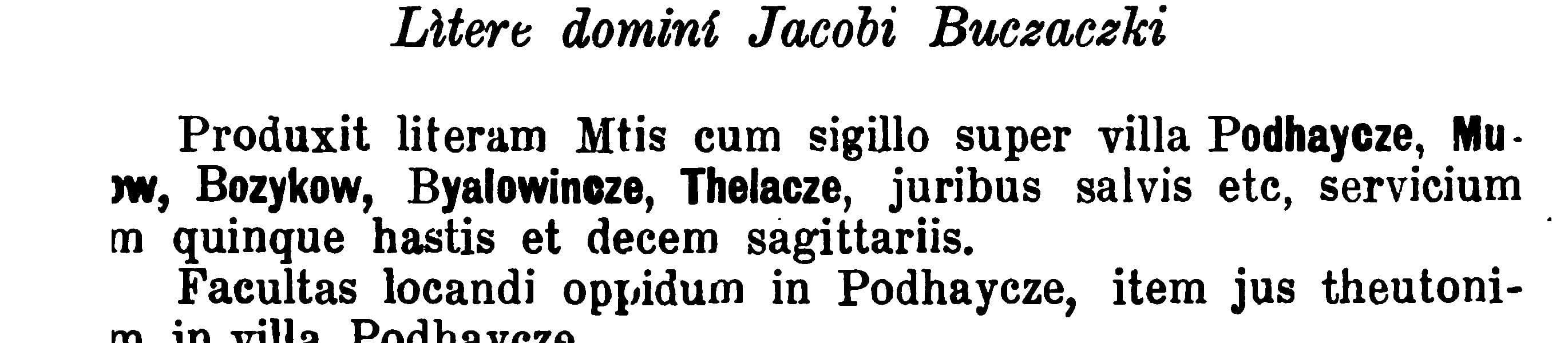
The entry, as printed
Litere domini Jacobi Buczaczki. Produxit literam Mtis cum sigillo super villa Podhaycze, Muzylow, Bozykow, Byalowincze, Thelacze, juribus salvis etc, servicium cum quinque hastis et decem sagittariis. Facultas locandi oppidum in Podhaycze, item jus theutonicum in villa Podhaycze.
In English
Charters of lord Jakub Buczacki. He showed a charter of His Royal Majesty with a seal for the village of Pidhaitsi, Muzhyliv, Bozhykiv, Biliavyntsi, Teliache, with rights reserved etc.; service with five lances and ten archers. Leave to found a town in Pidhaitsi, and German law in the village of Pidhaitsi.
A first mention on a map?
Of Biliavyntsi on the Strypa, Wikipedia says the village is marked on Guillaume de Beauplan’s map of Podolia of 1650, “which can be regarded as the first known written mention”. A map is a good source, but far from the oldest.
Jakub Buczacki’s charter, 1469
In the spring of 1469 royal officials in Ruthenia checked the charters by which the gentry proved their rights to estates. Jakub Buczacki showed “a charter of His Royal Majesty with a seal” for the villages of Pidhaitsi, Muzhyliv, Bozhykiv, Biliavyntsi and Teliache. From them he owed the king five lances and ten archers. The same entry records leave “to found a town in Pidhaitsi” under German law.
The inspectors did not note when the charter itself was issued. So 1469 is the latest possible date, and Biliavyntsi may well be older.
1578: “all burned by the Tatars”
More than a century later Biliavyntsi appears in the tax register of Halych district, again together with Pidhaitsi. The line reads like a verdict: “Villages belonging to the town of Pidhaitsi. All burned by the Tatars.” Then comes a list without a single number: Old Pidhaitsi, Letiatyn, Kryve, Petlykivtsi, Biliavyntsi, Lytvyniv, Bozhykiv, Voloshchyzna, Novosilka, Silka, Teliache, Muzhyliv, Rudnyky.
No tax was taken from burned villages, so there was no need to count their fields.
How we know it is our Biliavyntsi
There is no other village of that name in Galicia. Both documents place Biliavyntsi in the Pidhaitsi estate of the Buczacki family with the same neighbours, Muzhyliv, Bozhykiv and Teliache, and in 1578 next to Old Petlykivtsi, where the parish of Biliavyntsi was in the nineteenth century.
Only the distance is puzzling: Biliavyntsi lies on the Strypa, some twenty kilometres from Pidhaitsi, while the other villages of the estate cluster around the town. Biliavyntsi and Petlykivtsi were probably an outlying part of the estate, but that is our guess.
Sources
- A. Jabłonowski, Źródła dziejowe, vol. XVIII, part 1 (Warsaw, 1902), appendix “Lustratio an. 1469”, “Terra Galiciensis”, p. 39.
- Ibid., p. 91: the 1578 register of Halych district.
- Słownik geograficzny Królestwa Polskiego, vol. I (Warsaw, 1880), entry “Bielawińce”.
© 2026 Vadym Ratynskyi. All rights reserved. The research, text and translations on this page may be copied or republished only with the author's permission. To ask for permission, write to hello@ukrainianhomecoming.com.
Is your family from Biliavyntsi?
These records are about lords and land. Your ancestors are far more likely to be in the parish registers of the 18th to 20th centuries, and for most villages of this area some of those books survive, in archives in Ukraine and in Poland. A $140 records check tells you what exists for your village before you pay for anything larger.
Our Archive Discoveries
6 June 1477 (a town by 1480)
Staryi Nyzhbirok
77 years earlier
1469 (at the latest)
Zolotnyky
a town 16 years earlier
23 January 1548
Soroka
111 years earlier
11 November 1521
Ostriv
60 years earlier
12 October 1519
Horodnytsia
265 years earlier
9 December 1448
Shybalyn
27 years earlier
22 May 1497
Burkaniv
67 years earlier
16 July 1449
Khorostkiv
115 years earlier
30 January 1441
Petrykiv
17 years earlier
Start with a request. It costs nothing.
You write us the family name and whatever you know. We write back honestly: what can be found, what cannot, and what it would cost in your case. No payment, no obligation.