Our Archive Discoveries
Kryve near Kozova is 183 years older: Martin the tivun, 1443
Kryve · Kozova hromada, Ternopil raion, Ternopil oblast, Ukraine
A village near Kozova, next to Kalne
Wikipedia says Kryve was first mentioned in 1626 and retells a story that the Tatars burned an older village called Khomene that year. Yet a Lviv court recorded “Martin of Kryve, tivun” of the starosta of Terebovlia as early as 1443, together with the otaman of neighbouring Kozova.
Research and text: Vadym Ratynskyi
- In the record
- May 1443
- Usually given
- 1626
- Difference
- 183 years earlier
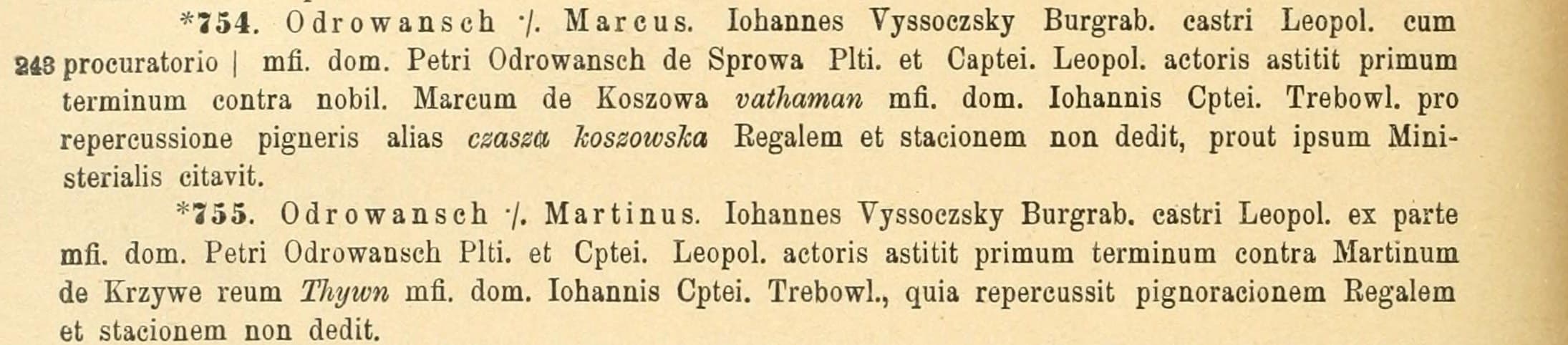
The entry, as printed
*754. Odrowansch ·/. Marcus. Iohannes Vyssoczsky Burgrab. castri Leopol. cum procuratorio mfi. dom. Petri Odrowansch de Sprowa Plti. et Captei. Leopol. actoris astitit primum terminum contra nobil. Marcum de Koszowa vathaman mfi. dom. Iohannis Cptei. Trebowl. pro repercussione pigneris alias czasza koszowska Regalem et stacionem non dedit, prout ipsum Ministerialis citavit. *755. Odrowansch ·/. Martinus. Iohannes Vyssoczsky Burgrab. castri Leopol. ex parte mfi. dom. Petri Odrowansch Plti. et Cptei. Leopol. actoris astitit primum terminum contra Martinum de Krzywe reum Thywn mfi. dom. Iohannis Cptei. Trebowl., quia repercussit pignoracionem Regalem et stacionem non dedit.
In English
No. 754. Jan Wysocki, burgrave of Lviv Castle, with the mandate of the magnificent lord Piotr Odrowąż of Sprowa, voivode and starosta of Lviv, the plaintiff, appeared at the first term against Marko of Kozova, otaman of the magnificent lord Jan, starosta of Terebovlia, for repelling the pledge, namely the royal “Kozova cup”, and for not giving quarters, as the court officer had summoned him. No. 755. Jan Wysocki, burgrave of Lviv Castle, on behalf of the magnificent lord Piotr Odrowąż, voivode and starosta of Lviv, the plaintiff, appeared at the first term against Martin of Kryve, the defendant, tivun of the magnificent lord Jan, starosta of Terebovlia, because he repelled the royal distraint and did not give quarters.
A date from a story
Of Kryve near Kozova, Wikipedia says “the first mention dates from 1626” and retells that in that year the Tatars burned an older village, Khomene, which stood by the forest. No source is given. Of neighbouring Kalne it says the first mention is from 1473.
In fact Kryve appears in the records two centuries earlier. And not alone, but together with Kozova.
May 1443: a tivun and an otaman
In May 1443, in the Lviv castle court, the burgrave Jan Wysocki appeared on behalf of the voivode of Ruthenia, Piotr Odrowąż, against two village officials at once. The first was “Marko of Kozova, otaman of the magnificent lord Jan, starosta of Terebovlia”. The second was “Martin of Kryve, tivun” of the same lord.
Both had repelled a royal distraint and refused quarters to the king’s men. In Marko’s case the clerk even gave the Ruthenian name of the tribute behind it all: the “Kozova cup”. A tivun was the steward of a lord’s estate. So by 1443 Kryve had its own official and belonged to Jan Buczacki, starosta of Terebovlia, one of the most powerful lords in the region.
1448: Artym of Kryve and the otaman of Kalne
Five years later, on 14 August 1448, the voivode’s deputy again complained about the same lord’s people. This time “Artym of Kryve and another, the otaman of Kalne, [men] of lord Jan of Lytvyniv” had refused quarters on the appointed day, again over the “Kozova cup”. The court found them in contempt and fined them three marks to the court and fourteen to the king.
This entry also gives neighbouring Kalne a date a quarter of a century earlier than Wikipedia’s: 1448 instead of 1473.
How we know it is our Kryve
There are several villages called Kryve in Galicia. But the 1448 entry ties our Kryve to Kozova and Kalne by a single debt: all three villages answer together for the same “Kozova cup” and belong to the same lord. Jan Buczacki styled himself “of Lytvyniv”, and Lytvyniv lies not far away, in the neighbouring Pidhaitsi hromada.
Today Kozova, Kryve and Kalne are neighbours in one Kozova hromada.
Otamans, tivuns and the story of Khomene
Who represented these villages in court is interesting too: an otaman in Kozova, an otaman in Kalne, a tivun in Kryve. Otaman was the title of a village headman, notably in villages under Wallachian law, settled by herders from the Carpathians. But an otaman could also lead an ordinary Ruthenian village, so these entries do not prove Wallachian law.
As for Khomene, the fifteenth-century records neither confirm nor refute the story: they simply know the village under its present name. Perhaps the name Khomene survives in a field or a tract. Those who remember it may know more than the documents.
Sources
- Akta grodzkie i ziemskie, vol. XIV (Lviv, 1888), p. 96, nos. *754–755 (Lviv castle court, May 1443).
- Ibid., p. 271, no. 2112 (14.08.1448).
© 2026 Vadym Ratynskyi. All rights reserved. The research, text and translations on this page may be copied or republished only with the author's permission. To ask for permission, write to hello@ukrainianhomecoming.com.
Is your family from Kryve?
These records are about lords and land. Your ancestors are far more likely to be in the parish registers of the 18th to 20th centuries, and for most villages of this area some of those books survive, in archives in Ukraine and in Poland. A $140 records check tells you what exists for your village before you pay for anything larger.
Our Archive Discoveries
1733
Samoluskivtsi
the village settled a second time
5 February 1450
Zwięczyca
222 years earlier
8 July 1437
Hnatkowice and Drohojów
92 years earlier
28 September 1436
Pobitno
153 years earlier
13 June 1463
Torki
126 years earlier
5 May 1438
Ciemięrzowice
first dated record
23 November 1444
Paportno
first dated record
8 October 1436
Prałkowce
38 years earlier
1 December 1446
Jasionka
first dated record
19 June 1486
Wojtkowa
186 years earlier
28 October 1437
Trójca
326 years earlier
1 March 1502
Średnia
first dated record
15 November 1424
Świlcza
first dated record
6 June 1477 (a town by 1480)
Staryi Nyzhbirok
77 years earlier
1469 (at the latest)
Zolotnyky
a town 16 years earlier
23 January 1548
Soroka
111 years earlier
1469 (at the latest)
Biliavyntsi
181 years earlier
11 November 1521
Ostriv
60 years earlier
12 October 1519
Horodnytsia
265 years earlier
9 December 1448
Shybalyn
27 years earlier
22 May 1497
Burkaniv
67 years earlier
16 July 1449
Khorostkiv
115 years earlier
30 January 1441
Petrykiv
17 years earlier
Start with a request. It costs nothing.
You write us the family name and whatever you know. We write back honestly: what can be found, what cannot, and what it would cost in your case. No payment, no obligation.